[Note: Originally published in May 2013 for the St. Mary’s High School blog and the Colorado Catholic Herald. ]
Every 7-year-old dreams of what he will be when grows up. For most, those dreams remain just that as other ambitions take over. But 7-year-old Richard “Nick” Nickelson’s dream of being a Navy “frogman” would provide him with amazing experiences, including playing a part in the historic last flight in the Mercury space program.
The dream began to really take shape when Nickelson was a senior at St. Mary’s High School in Colorado Springs. That year Nickelson and his best friend, Don “BJ” Bjornsrude, joined the Naval Reserve. The unit trained at Prospect Lake, the only body of water in Colorado Springs. Upon graduation from St. Mary’s in 1960, the pair went into active duty with the Navy.
While Nickelson had struggled in high school, he graduated in the top of his class from the Basic Underwater Demolition/SEAL (BUD/S) course. He wasn’t an original candidate for the Navy’s Astronaut Recovery Teams; in fact, Nickelson hadn’t even started his BUD/S training when the original teams were chosen in 1961. By the time he graduated from BUD/S in July 1962, only two Mercury flights remained, and it seemed unlikely that Nickelson would on one of the recovery teams.
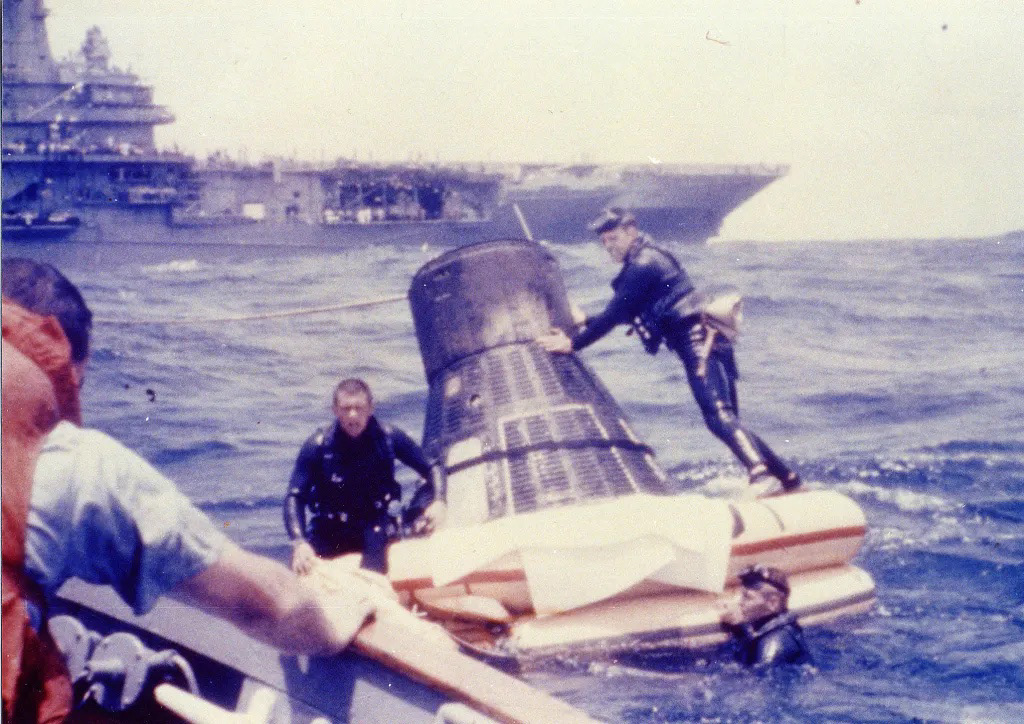
But around noon on May 16, 1963, Nickelson climbed aboard a helicopter located on the deck of the USS Kersarge, a Navy ship charged with the recovery of the Faith 7 Mercury space capsule. In the next 30 to 45 minutes, Nickelson expected to be in the water, attaching a flotation collar to astronaut Gordon Cooper’s capsule as part of the Astronaut Recovery Team.
As he waited, Nickelson thought about the journey that brought him to be part of the team. A job with the space program was something he had never imagined.
“When I was in high school, even the year I graduated, not a lot was known about the space program,” he said. “Seven men were selected to be astronauts but they only had six flights.”
By September 1962, Nickelson was deployed to Cuba as part of the UDT Detachment unit during the Cuban Missile Crisis where he would serve until December 1962. Five months before he helped with the historic Mercury mission, being a part of the space program still wasn’t on Nickelson’s radar.
But God had bigger plans for Nickelson than he had had for himself. In February 1963 Nickelson learned of two openings in the Astronaut Recovery Program. After announcing the openings, his commanding officer told the men that if they were interested they needed to get in line to sign up for a drawing. Nickelson ended up being about the 70th man in line, and wondered about his odds of getting the assignment. So he decided to take the matter into his own hands.
“Everyone wanted this,” Nickelson said. “I decided to go in and ask for it. I was confident in my abilities and I think that really helped.”
The gamble worked. Nickelson was given one of the openings and would be one of the three men on the primary recovery team for Cooper’s Faith 7 flight. Nickelson and the other members of the flight crew spent three months working with Cooper. As they practiced placing the floatation device, they got to know the astronaut and gained his trust.
“Cooper was a character,” Nickelson said. “He was fun. We met him to gain his confidence in what we were doing, but he was the one making jokes and keeping us going.”
On May 16, 1963, as the team waited for splash down, they received word that on reentry Cooper had lost communication with Cape Canaveral and that his onboard computer had failed. Given the situation it seemed more likely that Cooper would land in a contingency area, miles away from where Nickelson and his team waited.
“With no computer to signal the exact moment to fire his retro-rockets for reentry, and having no voice communication with the Cape, Cooper would have only his wristwatch to rely on,” Nickelson writes in his book Hooyah! UDT/SEAL Stories of the 1960s. “So precise was the timed firing of the retro-rockets, simply missing the mark by one second meant Cooper would overshoot the primary recovery area by one hundred miles.”
Missing by 10 seconds would mean that the capsule would bounce off the Earth’s atmosphere and be lost in space. The team stayed in place as they waited to see what would happen. Everyone was apprehensive as the fate of Faith 7 hung in the balance.
Incredibly Cooper did what was next to impossible—he had timed the rockets perfectly and landed within four miles of the USS Kersarge, which was in the Pacific Ocean near Midway Island.
“We were so close to the capsule, it seemed as though I could reach out and touch it,” Nickelson said.
The recovery team had to wait until the parachute was released from the capsule before they could go into the water. But within minutes of splash down, the team was in the water towing the flotation collar toward the capsule—a collar that bore the large initials UDT, which Nickelson had drawn on it to prevent other military units from trying to claim ownership over the recovery. Nickelson said the installation went smoothly, proving that their three-months training had paid off.
Nickelson’s boyhood dream of being a Navy frogman, which had never waivered, had taken him to places to he never dreamed.
“It was a very interesting time and something I never thought I would do,” Nickelson said. “All through high school, I lived and breathed the dream of being a frogman. People didn’t believe I could do it, but I joined anyway.”
Nickelson’s successes in the Navy have played a role in his post-frogman life as well. Upon leaving the Navy, Nickelson settled in California and graduated from Pepperdine University. Then in 1991, he established a nonprofit group to assist homeless veterans. The Kenny Nickelson Memorial Foundation for Homeless Veterans and Children, named for Nickelson’s son who died at the age of 23, has assisted more than 100,000 veterans and their families. Nickelson said his Navy career and the part he played in the Mercury program has opened doors to get much needed funding for the organization.
“God had a plan and he allowed me to do these things because he knew it would benefit us when we started the foundation,” Nickelson said.
Through everything in Nickelson’s life, God has remained a constant. His faith was encouraged at St. Mary’s High School and was something that gave him a lot of strength during his Navy missions and his role in the recovering of Faith 7.
“I recently found a letter I wrote to my mom on the day of the recovery,” Nickelson said. “It said, ‘This is the proudest moment of my life.’ It was an adventure, and even today I see it as clearly as I did the day it happened.”
By Amy G. (Partain) Park
Director of Communications/Marketing, St. Mary’s High School
 Amy G. Park